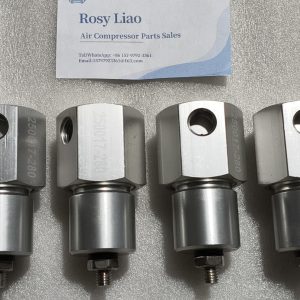
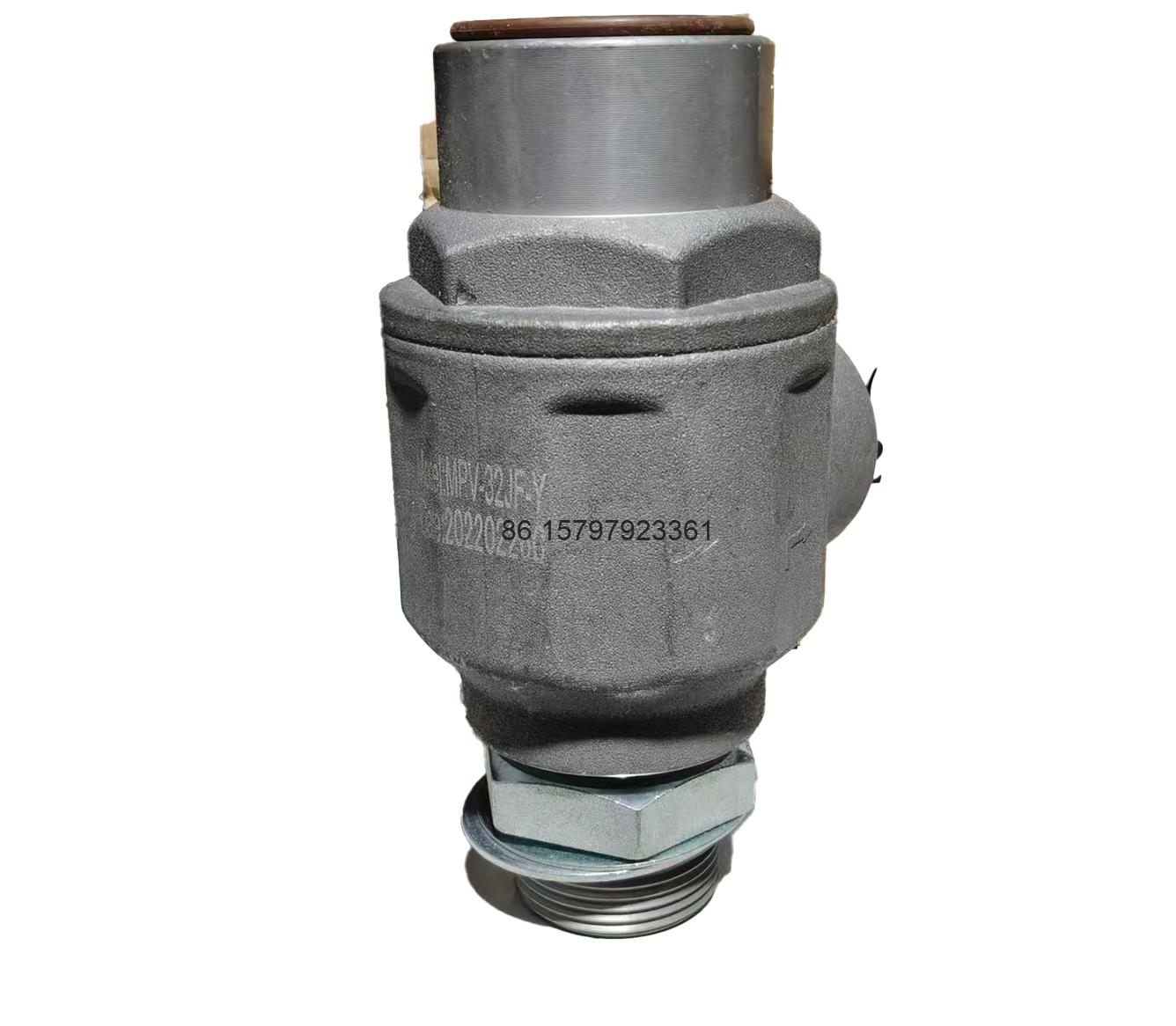
32JF-Y Minimum Pressure Valve
Product description:
- Holds minimum pressure in the separator tank — the valve stays closed until the tank pressure reaches the calibrated opening value (typically around 0.4 MPa / 4 bar). By keeping pressure inside the tank, it makes sure the oil-laden compressed air is properly separated in the separator element, which directly reduces oil carryover and oil loss.
- Builds oil circulation pressure — the pressure held in the tank pushes lubricating oil through the oil circuit to the screw element and bearings, guaranteeing lubrication and cooling during start-up and low-load running. Without this pressure, the machine can overheat very quickly.
- Protects the oil separator element — by controlling the flow rate and avoiding sudden large pressure differences, the valve shields the precision separator element from pressure shock and extends its service life.
- Works as a check valve — when the compressor unloads or stops, the valve closes automatically and stops compressed air in the downstream piping from flowing back into the compressor.
Product Advantages
- DN32 (1-1/4″) threaded JF connection — compact screw-in design that fits directly into the separator outlet of compressors using a 32JF-type valve; easy to install even in tight spaces.
- Reliable pressure holding — the calibrated spring keeps the separator tank pressure above the required minimum, ensuring consistent oil separation and lubrication across all load conditions.
- Reduces oil carryover and oil consumption — enough holding pressure lets the separator element remove oil droplets effectively, so less oil escapes into the downstream air line and oil consumption stays within normal range.
- Guarantees lubrication and prevents overheating — the retained tank pressure drives oil to the screw element and bearings, protecting the machine from overheating and premature wear, especially at start-up and low load.
- Protects the expensive separator element — controlled opening avoids sudden pressure shocks and large pressure differences across the separator element, lengthening the service life of this precision filter.
- Prevents air backflow — acts as a dependable check valve when the compressor unloads or stops, preventing compressed air in the piping from blowing back into the machine.
- Durable metal construction — quality metal valve body, piston and spring, paired with reliable sealing rings, built to withstand continuous high-pressure compressor working conditions.
- Adjustable opening pressure — the adjusting screw allows the opening pressure to be checked and set to match your machine’s required value.
- Correct -Y variant — manufactured to match the 32JF-Y specification; if your original valve is marked 32JF-Y, this is the direct replacement.
FAQ
A: It is a pressure-control and check valve fitted at the outlet of the oil-gas separator tank on an oil-injected screw air compressor. It holds a minimum pressure inside the separator tank (so oil is properly separated and lubricating oil circulates correctly), protects the separator element from pressure shock, and prevents compressed air from flowing back when the machine unloads or stops.
A: “32” = nominal size DN32 (1-1/4″); “JF” = threaded (female-thread) connection type; “-Y” = the specific variant of this model. This valve fits oil-injected rotary screw air compressors that use a 32JF-Y minimum pressure valve. Before ordering, please confirm the model marking on your original valve (32JF-Y or equivalent) and the connection size, or send us your compressor model and we will help you confirm.
A: Both are variants of the same 32JF minimum pressure valve series, with the same DN32 threaded connection. The “-Y” and “-N” suffixes identify different production variants / specifications. You should always match the suffix marked on your original valve. If your old valve is marked 32JF-Y, order the 32JF-Y; if it is marked 32JF-N, order that version instead. If you are not sure, send us a photo of the old valve.
A: It is installed at the compressed-air outlet of the oil-gas separator tank (usually on the upper part of the separator barrel), between the separator element outlet and the aftercooler / downstream piping.
A: Minimum pressure valves for screw compressors are typically calibrated to open at around 0.4 MPa (4 bar / ~58 psi), though the exact set value depends on your machine’s specification. The opening pressure can be checked and adjusted via the adjusting screw to match your compressor’s requirement. Please confirm the set pressure your machine needs before ordering.
A: Common signs include: excessive oil in the compressed air (oil carryover), higher-than-normal oil consumption, the compressor overheating due to poor oil circulation, inability to reach the rated discharge pressure, unstable or fluctuating outlet pressure, and air blowing back from the machine when it stops. Any of these can indicate the valve is stuck, the spring has weakened, or the seals have failed.
A: A basic in-machine check: start the compressor and watch the separator tank pressure. The tank pressure should build up to the calibrated opening value (around 0.4 MPa) before air starts flowing to the downstream line. If air flows out immediately at very low pressure, the valve is likely stuck open; if the tank pressure keeps rising but no air reaches the outlet, the valve may be stuck closed. For an accurate result, remove the valve, inspect the piston, spring and seals, and test the opening pressure on a test bench.
A: Replace it when the machine shows the symptoms above, when the valve fails the opening-pressure test, when air or oil leaks appear around the valve body, or during a major overhaul after long service hours. The 32JF-Y is supplied as a complete valve assembly (valve body, piston / core, spring and seals). If you only need a repair kit (seals / spring) instead of the full valve, please contact us separately.
A: No — the 32JF-Y is a compact, threaded maintenance part that can be replaced directly by service technicians familiar with the machine. Before installation, release all pressure from the system, clean the valve seat and threads, fit the new valve with the correct seals (use thread sealant as appropriate), and after installation verify the opening pressure and check for air leaks. If in doubt, contact us for installation guidance.
Get a Quote for Your Compressor Part
Looking for the right replacement part? Send us your part number, compressor model, or dimensions, and our team will help you confirm the correct product.