
49147135=23700370 Interchangeable Pressure Sensor
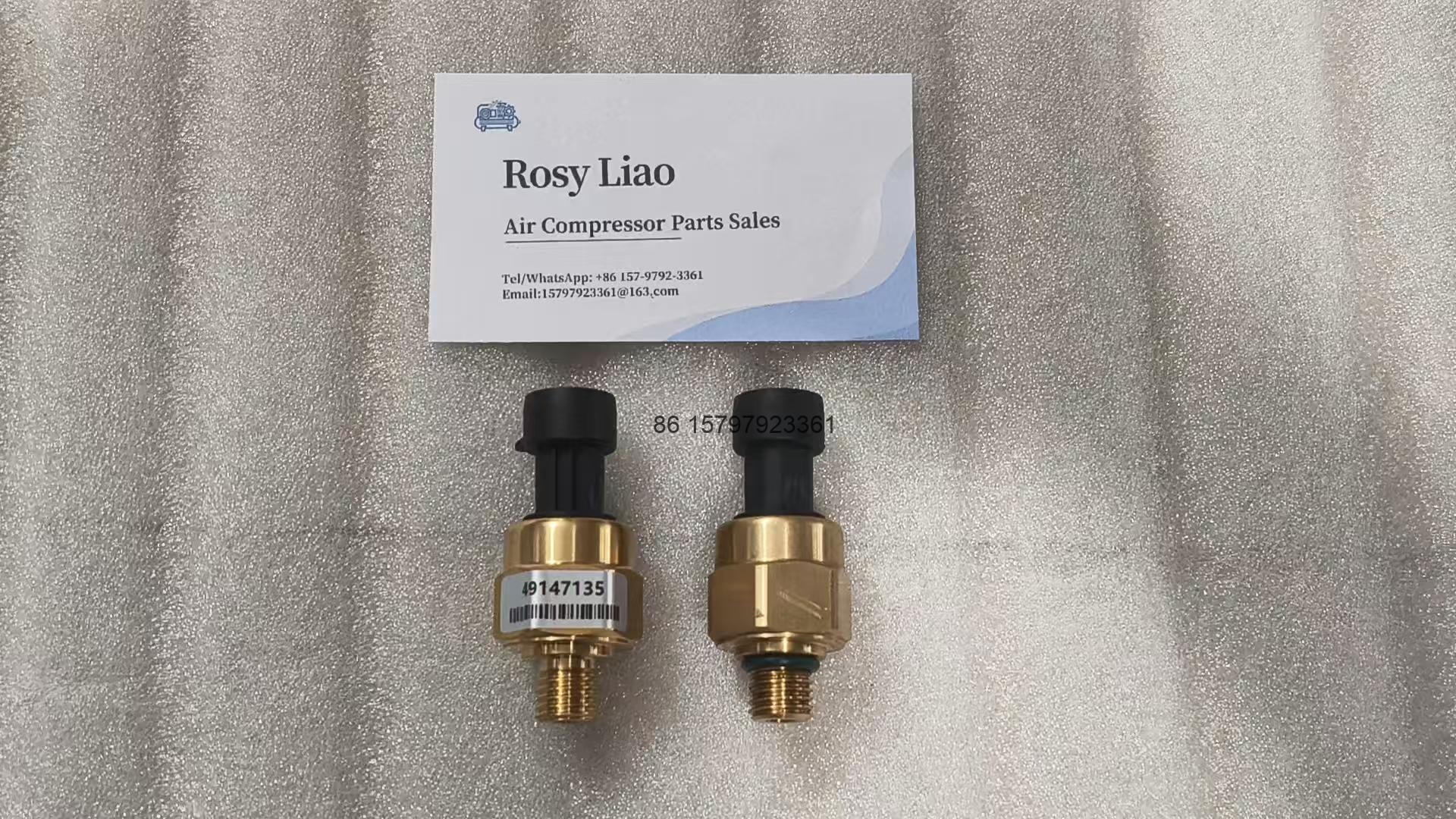
Product description:
- The sensor / transducer converts the pressure (or vacuum) it senses into an electrical signal that the controller can read.
- The controller uses the pressure / vacuum reading to run the compressor correctly (loading, unloading, pressure regulation).
- A faulty sensor gives an incorrect or failed reading, so the controller cannot regulate the system correctly.
| Item | Specification |
|---|---|
| Part numbers | 49147135 = 23700370 (interchangeable, per listings) |
| Part type | Pressure sensor / pressure transducer (vacuum-capable) |
| Referenced spec | 49147135: 0–15 psi pressure / 0–15 psig vacuum sensor (per listings) |
| Application | Ingersoll Rand screw air compressors (per listing) |
| Also grouped with | 23700388 (0–15 psig vacuum sensor, per listing); 22359632, 23700370 family (per listings) |
| Measurement range / electrical spec | [Confirm against original sensor] |
Product Advantages
- Two interchangeable part numbers — 49147135 / 23700370 are cross-referenced as interchangeable IR sensors (per listings), so you can match whichever number your machine references.
- Known range — 49147135 is referenced at 0–15 psi (pressure) / 0–15 psig (vacuum) for the corresponding IR position (per listings).
- Vacuum-capable — can serve the IR screw-compressor pressure / vacuum sensing position (per listing).
- OEM-reference matched — replacement sensors manufactured to match the Ingersoll Rand pressure sensor specification.
- Accurate pressure monitoring — correct reading lets the controller regulate loading / unloading and working pressure properly.
- Stable system pressure — avoids the unstable pressure caused by a faulty sensor.
- Protects efficiency — correct control avoids unnecessary loading / unloading and wasted energy.
- Prevents false trips / alarms — a working sensor stops the incorrect readings that cause alarms and shutdowns.
FAQ
A: It is the pressure / vacuum sensor (pressure transducer) of an Ingersoll Rand screw air compressor. It measures the pressure or vacuum and sends a signal to the controller, which uses the reading to regulate loading, unloading and the working pressure.
A: Per public listings, 49147135 and 23700370 are cross-referenced as interchangeable IR pressure / vacuum sensors. Please confirm the number on your original sensor and your machine model before ordering.
A: Per listings, 49147135 is referenced at 0–15 psi as the IR screw-compressor pressure sensor, and grouped with 23700388 as a 0–15 psig vacuum sensor. Please confirm the range matches your machine’s requirement before ordering.
A: Per listing this is the pressure / vacuum sensor for IR screw air compressors. Please confirm the exact machine model and the sensor spec against your original part before ordering; if you are not sure, send us your machine details and we will help you confirm.
A: Per listings, 49147135 is grouped with 23700388 (0–15 psig vacuum sensor); 23700370 is grouped with 22359632 / 23700388 and with 39875539 / 23451867. Please confirm the correct number for your machine before ordering.
A: The sensor converts the pressure (or vacuum) it senses into an electrical signal that the controller can read. The controller uses the reading to load the compressor when pressure is low and unload when the set pressure is reached, keeping the system within the working range.
A: Common signs include: unstable or incorrect system pressure, the compressor loading / unloading at the wrong times, pressure readings that are inaccurate, erratic or failed, and repeated pressure alarms or trips. Any of these can indicate the sensor needs replacing.
A: Compare the sensor reading against a known-good gauge / the actual system pressure (or vacuum). If the reading is inaccurate, erratic or missing, the sensor may be faulty. Check the wiring / connector first, then confirm the sensor against the original specification before replacing.
A: These are replacement sensors manufactured to match the Ingersoll Rand OEM specification; if you require original Ingersoll Rand parts, please let us know. Replacing the sensor is normally a straightforward swap carried out by service technicians: isolate and depressurize the line, disconnect the wiring, replace the sensor, reconnect and verify the reading after restart. If you need service guidance, please contact us.
Get a Quote for Your Compressor Part
Looking for the right replacement part? Send us your part number, compressor model, or dimensions, and our team will help you confirm the correct product.


